
Anon
Seamlessly integrate AI across platforms without direct APIs.
Contact for Pricing
-
Quick Info
Launch Date28 Mar '25
PricingContact for Pricing
Collections
Categories
Anon – Seamlessly integrate AI across platforms without direct APIs
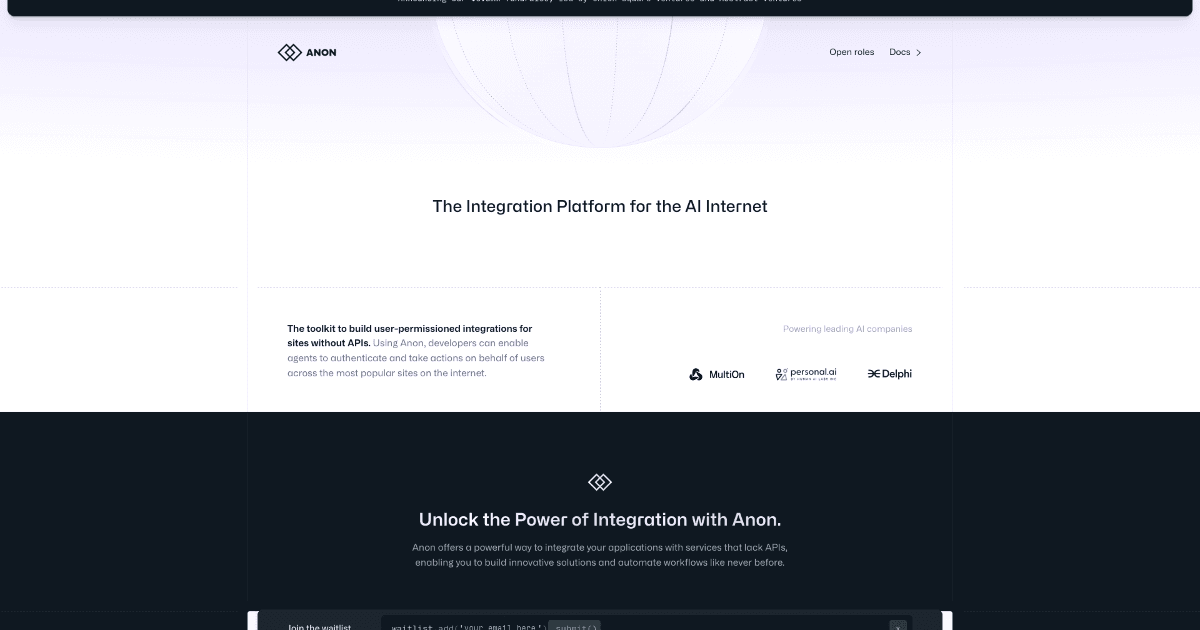
In the modern technology landscape, Anon emerges as a platform designed to bridge the gap between AI and application integration. Positioned as "The Integration Platform for the AI Internet," it revolutionizes how developers create user-permissioned integrations for platforms that traditionally lack APIs. This tool facilitates seamless interactions across popular internet services while ensuring these interactions are secure and user-controlled. Aimed at developers and businesses looking to enhance their applications with dynamic AI capabilities, Anon simplifies the integration process, making it more accessible and efficient.
For teams exploring AI automation tools, Anon offers a unique approach by enabling connections without the need for native API support from third-party services. This opens new possibilities for building intelligent applications that can interact with a wide range of online platforms.
What is Anon?
Anon is a middleware platform that allows developers to integrate AI agents and applications with various online services that do not offer public APIs. It acts as a secure bridge, handling authentication, session management, and data exchange between the user's application and the target platform. This enables AI-powered tools to perform actions—like booking flights, managing e-commerce orders, or sending messages—across the internet through a standardized interface.
The core value proposition is granting AI systems the ability to operate in environments previously inaccessible due to API limitations. This is particularly relevant for the growing category of AI agents, which require robust interoperability to function effectively in real-world scenarios.
Key Features
Wide Range of Integrations: Supports services across airlines, e-commerce, messaging, and more, with a constantly expanding library.
Granular Session Control: Offers detailed management of user sessions, ensuring security and compliance.
Cross-Platform Compatibility: Works across mobile, web, and desktop environments.
Security-First Architecture: Employs a zero-trust model that never exposes or stores user credentials.
Developer-Friendly Tools: Provides SDKs for TypeScript, JavaScript, Python, with upcoming support for Go and Rust.
Use Cases
Tech Startups: Quickly integrating advanced, cross-platform features into new applications.
E-commerce Platforms: Connecting with logistics, delivery, and supplier services that lack direct APIs.
Healthcare Providers: Enabling secure, compliant data exchanges between disparate systems.
Educational Tools: Managing secure user sessions and data handling for learning platforms.
Underlying AI Models or Technology
Anon itself is an integration platform, not an AI model. Its technology enables other AI systems to connect and operate. The platform is designed to work with a variety of natural language processing models and AI agents that require real-world interaction capabilities. By handling the complex layer of authentication and session management, Anon allows AI agents to focus on higher-level language generation and decision-making tasks.
The platform's architecture likely utilizes techniques for understanding web interfaces and automating user-like interactions, which complements the cognitive abilities of modern AI models. This symbiosis allows developers to build agents that can not only understand requests but also execute them across the digital landscape.
Pricing
Anon offers a free tier for users to explore its core capabilities. A Pro tier begins at approximately $50 per month, providing additional features and higher usage limits. For the most accurate and current pricing details, including enterprise plans, please refer to the official Anon website.
Pros and Cons
Pros
Enables integrations with platforms that lack public APIs, unlocking new possibilities.
Significantly reduces development time for complex cross-platform features.
Strong focus on security and user privacy with a zero-trust architecture.
Cons
May present a learning curve for developers new to middleware and integration platforms.
Effectiveness can depend on the stability of the third-party services being integrated.
Alternatives
Developers seeking integration solutions may also consider platforms that offer API management, workflow automation, or specialized customer support solutions with built-in connectivity.
Zapier / Make (Integromat): Established platforms for connecting web apps with official APIs via visual workflows.
n8n: An open-source workflow automation tool that can be self-hosted.
Custom Development: Building direct integrations or using web scraping techniques, though this requires significant ongoing maintenance.
Frequently Asked Questions
Embed This Tool
Add this badge to your website to show that Anon is featured on AIPortalX.

Featured on AIPortalXAnon
to leave a comment