
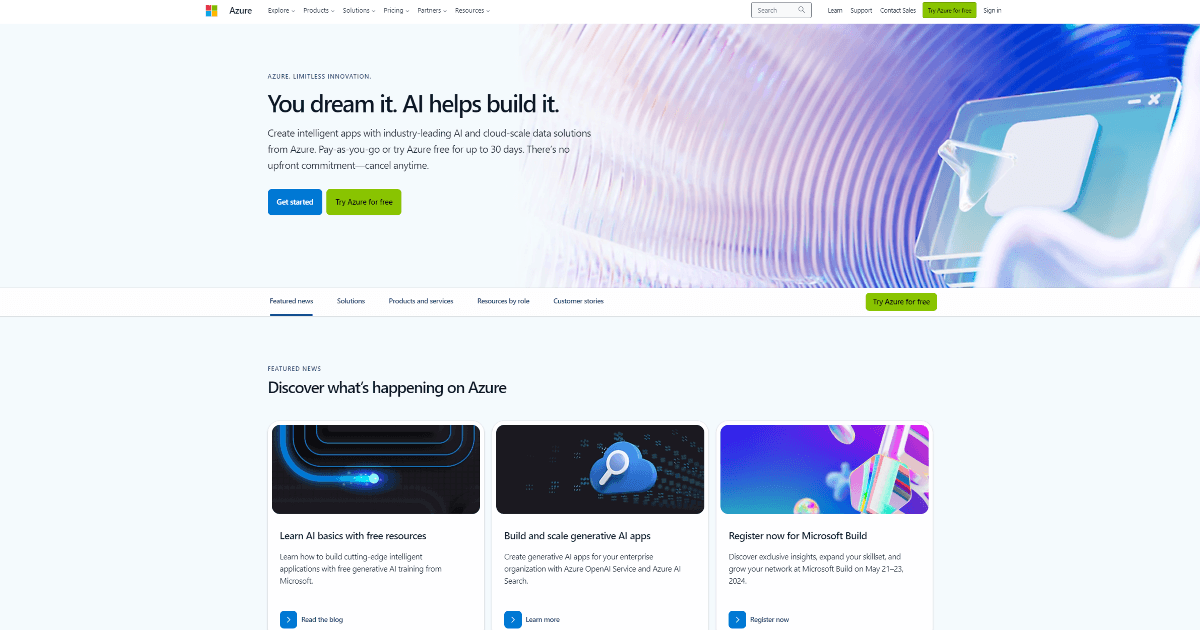
Microsoft Azure
Build, deploy, manage applications globally with Azure's cloud, AI, and hybrid capabilities.
Free Trial
-
Quick Info
Launch Date4 Aug '25
PricingFree Trial
Microsoft Azure – A comprehensive cloud platform for building, deploying, and managing applications globally.
Microsoft Azure is a leading cloud computing platform offering a vast array of services for compute, analytics, storage, and networking. It enables businesses to build, test, deploy, and manage applications through Microsoft's global network of data centers. Azure supports a wide range of programming languages, tools, and frameworks, making it a versatile choice for organizations of all sizes. Its extensive capabilities in AI and automation position it as a foundational tool for modern digital transformation.
The platform is designed to help businesses manage technical challenges and meet organizational goals, offering software as a service (SaaS), platform as a service (PaaS), and infrastructure as a service (IaaS). Its global infrastructure and hybrid cloud solutions provide the flexibility needed for today's complex IT environments, making it a popular choice for project management and enterprise-scale operations.
What is Microsoft Azure?
Microsoft Azure is a comprehensive cloud computing service created by Microsoft for building, testing, deploying, and managing applications and services through Microsoft-managed data centers. It provides software as a service (SaaS), platform as a service (PaaS), and infrastructure as a service (IaaS) and supports many different programming languages, tools, and frameworks, including both Microsoft-specific and third-party software and systems.
Azure is designed to help businesses manage challenges and meet their organizational goals. It offers a wide range of cloud services, including those for compute, analytics, storage, and networking. Users can pick and choose from these services to develop and scale new applications, or run existing applications, in the public cloud.
Key Features
Azure's extensive feature set supports a broad spectrum of business needs.
- Global Network: Azure operates on a global network of Microsoft-managed data centers across 54 regions, more than any other cloud provider. This global presence ensures high availability and redundancy for your applications and data.
- Hybrid Capabilities: Azure provides seamless hybrid cloud capabilities, allowing you to integrate and manage your environments across on-premises, multicloud, and at the edge with tools and services like Azure Arc.
- AI and Machine Learning: With Azure, you can build and deploy AI and machine learning models quickly using Azure Machine Learning, Azure AI Studio, and Azure OpenAI Service. The platform supports a wide range of AI development tools and frameworks.
- Security and Compliance: Azure offers robust security features that help protect your data. The platform is built with a commitment to privacy and compliance, supporting a broad set of international and industry-specific standards.
- Scalability and Flexibility: Azure allows you to scale up or down based on your needs, ensuring you only pay for what you use. Its vast array of services and applications provides unparalleled flexibility.
- Integrated Development Environment: Azure seamlessly integrates with Microsoft's Visual Studio, empowering developers with a powerful, efficient, and familiar environment to build their applications.
Use Cases
Azure serves a diverse range of industries and organizational needs.
- Enterprises: Leveraging Azure for global data management, disaster recovery, and business continuity strategies.
- Startups and SMBs: Utilizing Azure's scalability to grow with their evolving business needs without heavy upfront investments.
- Government Agencies: Employing Azure to improve operations and enhance public services while adhering to strict compliance and security standards.
- Healthcare Organizations: Using Azure to manage patient data securely, enhance patient care through AI, and streamline operations.
- Educational Institutions: Facilitating remote learning and research through scalable cloud resources.
- Non-profits: Leveraging Azure for cloud computing needs on a budget through special programs.
Underlying AI Models or Technology
Azure's AI capabilities are powered by a suite of services that leverage advanced machine learning and natural language processing models. Azure Machine Learning provides a platform for building, training, and deploying models, while Azure OpenAI Service offers access to powerful large language models for generative AI tasks. These services support a wide range of text generation capabilities, from content creation to code generation.
The platform also includes cognitive services for vision, speech, and decision-making, enabling developers to add intelligent features to applications without deep AI expertise. Azure's investment in AI infrastructure ensures businesses can leverage cutting-edge technology to build predictive models, analyze data in real-time, and create innovative, intelligent applications.
Pricing
Azure offers a flexible pricing model designed to accommodate various business needs and scales.
- Free Tier: Get started with 12 months of free services and $200 credit to explore Azure services for 30 days.
- Pay-As-You-Go: Flexible pricing based on resource consumption, with no upfront costs. Perfect for businesses looking to scale with demand.
- Reserved Instances: Save up to 72% compared to pay-as-you-go prices with one- or three-year upfront commitment on service usage.
Disclaimer: Please note that pricing information may not be up to date. For the most accurate and current pricing details, refer to the official Microsoft Azure website.
Pros and Cons
Pros
- Comprehensive Hybrid Cloud Solutions: Azure's hybrid cloud solutions offer the best of both worlds, allowing for easy mobility and a consistent platform between on-premises and cloud environments.
- Advanced Analytics and AI Capabilities: Azure's analytics and AI services enable businesses to analyze data in real-time and build predictive models, enhancing decision-making and creating new opportunities for innovation.
- Global Infrastructure: With data centers in more regions than any other provider, Azure ensures high availability, low latency, and data residency compliance.
Cons
- Complexity: The sheer breadth of services and capabilities can be overwhelming for new users, requiring a steep learning curve.
- Cost Management: While Azure offers a pay-as-you-go model, managing and optimizing costs can be challenging due to the complexity of pricing and billing structures.
- Support Costs: High-level support plans can be expensive, although they provide extensive resources and assistance.
Alternatives
While Azure is a market leader, other cloud platforms offer different strengths. For teams focused on productivity and collaborative work, integrated suites may be appealing.
- Amazon Web Services (AWS): The largest cloud provider by market share, known for its extensive service catalog and mature ecosystem.
- Google Cloud Platform (GCP): Excels in data analytics, machine learning, and open-source technologies, with strengths in containerization and Kubernetes.
- IBM Cloud: Offers strong hybrid cloud and AI solutions, particularly for enterprise clients with legacy systems.
- Oracle Cloud Infrastructure (OCI): A strong contender for database workloads and enterprise applications, with competitive pricing.
Frequently Asked Questions
Embed This Tool
Add this badge to your website to show that Microsoft Azure is featured on AIPortalX.

Featured on AIPortalXMicrosoft Azure
to leave a comment