
Guardrails
Enhance AI applications with robust validation and error correction.
Contact for Pricing
-
Quick Info
Launch Date4 Aug '25
PricingContact for Pricing
Collections
Categories
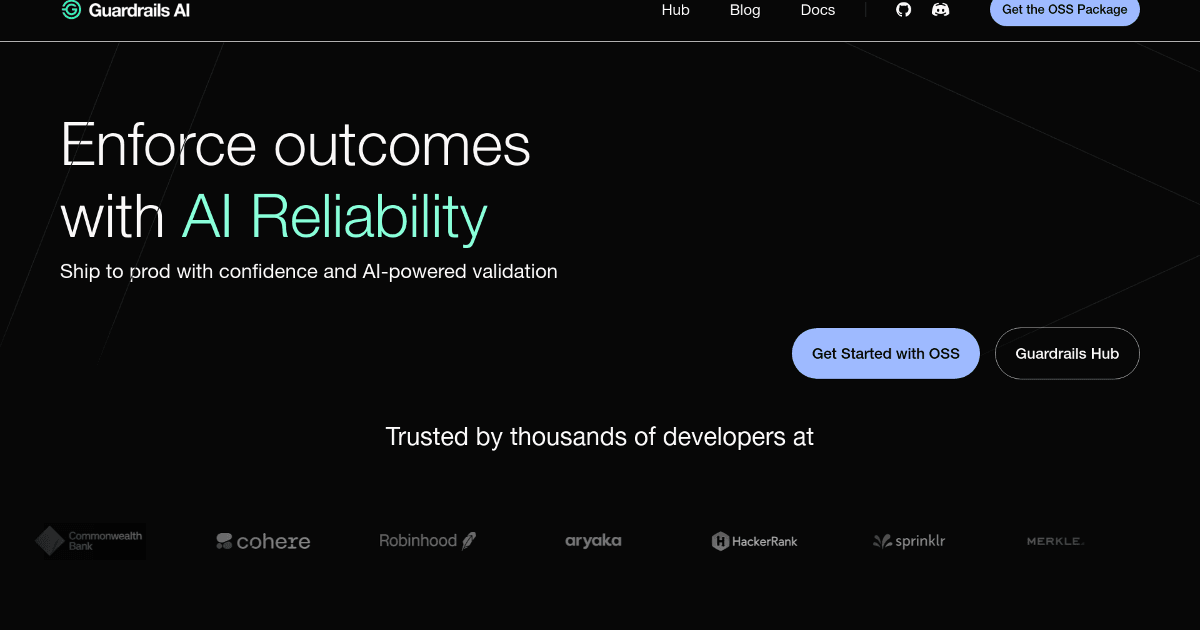
Guardrails – A robust framework for validating and correcting AI-generated content.
Guardrails is an innovative tool designed to enhance the development and management of AI applications. Its core functionality revolves around providing a robust framework for the validation of AI-generated content and interactions. Aimed at developers and AI project managers, Guardrails simplifies the process of ensuring that AI outputs are safe, accurate, and compliant with set standards and regulations. By integrating a library of pre-built validators and supporting flexible AI model providers, this tool is pivotal in shaping user experiences that are both reliable and efficient.
As part of the broader ecosystem of AI agents and automation tools, Guardrails addresses a critical need for reliability in AI-driven workflows. It is particularly valuable for teams building applications that rely on natural language processing models to generate content, answer questions, or interact with users.
What is Guardrails?
Guardrails is a developer-focused framework that provides a structured approach to validating and correcting outputs from large language models (LLMs) and other AI systems. It acts as a safety layer between the AI model and the end-user application, ensuring generated content meets predefined criteria for safety, accuracy, and format.
The tool is designed to be model-agnostic, working with various AI providers. Its primary goal is to reduce hallucinations, enforce compliance, and improve the overall trustworthiness of AI applications, making it a foundational component for serious AI agent development.
Key Features
- Pre-built Validators Library: Access a comprehensive library equipped with custom validators for a wide range of use cases.
- Flexible AI Model Support: Compatible with various AI model providers, ensuring adaptability across different projects.
- Pydantic-Style Validation: Ensures that the outputs of Large Language Models (LLMs) meet expected standards of precision and reliability using a familiar schema definition.
- Corrective Actions: Provides mechanisms to automatically rectify or re-prompt for errors in AI outputs, enhancing application reliability.
- Customization Flexibility: Allows developers to tailor validators and corrective logic according to specific project requirements.
Use Cases
- Tech Startups: Implementing Guardrails to ensure their AI-driven applications meet industry standards for safety and accuracy before deployment.
- Software Developers: Using the tool to validate and manage AI outputs in software development projects, such as automated code generation or documentation.
- AI Researchers: Employing Guardrails for experimental AI projects to ensure outputs are reliable, measurable, and safe for analysis.
- Educational Institutions: Leveraging the tool in AI courses to teach students about application safety, output validation, and responsible AI development.
Underlying AI Models or Technology
Guardrails is built as a middleware layer that sits on top of existing AI models. It is not an AI model itself but a framework designed to work with various providers of large language models (LLMs). Its technology focuses on parsing, validating, and potentially correcting the unstructured text or data generated by these underlying models.
The framework utilizes validation schemas, often defined in a Pydantic-style, to check for correctness, bias, toxicity, or format. When a validation fails, it can trigger corrective actions like filtering the output, asking the LLM for a re-generation, or executing custom code. This makes it particularly relevant for applications leveraging advanced text generation capabilities where output quality is paramount.
Pricing
Guardrails operates on a "Contact for Pricing" model. Historically, it has offered a free tier for basic exploration and a Pro tier with advanced features. For the most accurate and current pricing details, including any free offerings or tier structures, please refer to the official Guardrails website.
Pros and Cons
Pros
- Significantly improves the reliability and safety of AI application outputs through stringent validations.
- Offers an intuitive setup and developer-friendly interface, reducing the learning curve for integration.
- Easily scales to accommodate the growing complexity and volume needs of enterprise AI projects.
Cons
- Might require initial technical knowledge and effort to integrate fully into complex existing systems.
- Relies on the performance and limitations of the underlying third-party AI models it is validating.
Alternatives
Developers seeking similar validation and safety layers for AI applications might consider these alternatives. For a broader view of tools in this space, explore the research and discovery category.
- LangChain: A broader framework for building applications with LLMs that includes components for chaining, memory, and some validation.
- Microsoft Guidance: A tool from Microsoft designed to control the output of LLMs through constrained generation and formatting.
- Instructor: A library that leverages Pydantic to structure LLM outputs, focusing on extracting structured data from unstructured text.
Frequently Asked Questions
Embed This Tool
Add this badge to your website to show that Guardrails is featured on AIPortalX.

Featured on AIPortalXGuardrails
to leave a comment