
Guardrail Technologies
Control who AI can see, store, reveal.
Contact for Pricing
-
Quick Info
Launch Date4 Dec '25
PricingContact for Pricing
Guardrail Technologies – Enterprise-grade control and security for generative AI workflows
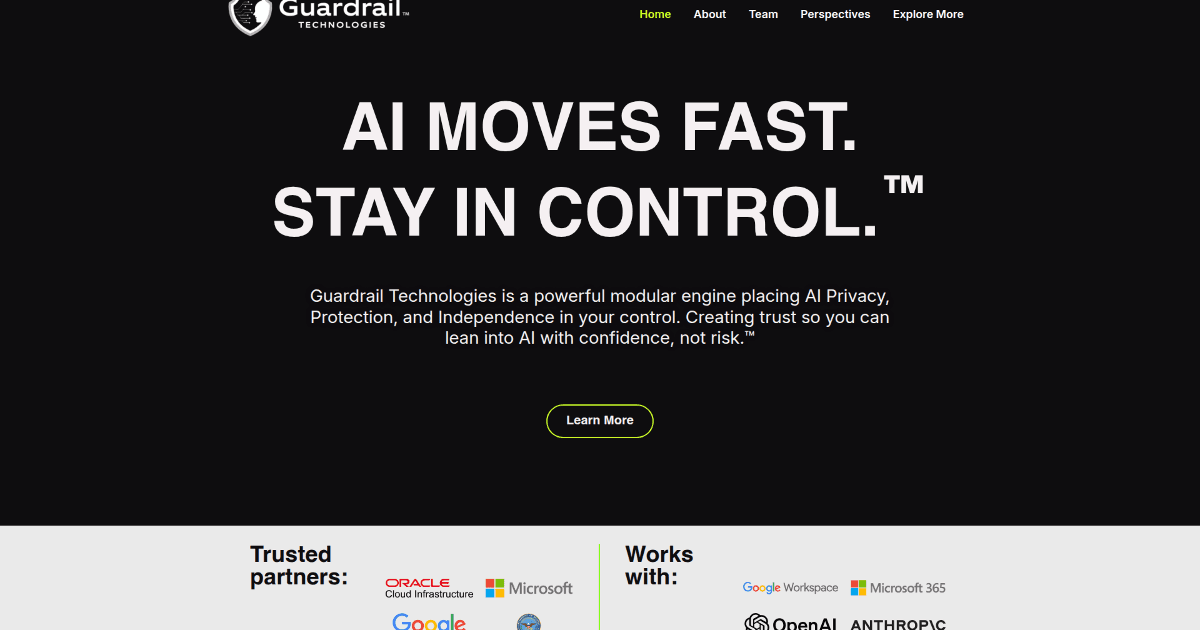
Guardrail Technologies provides a critical security layer for organizations adopting generative and agentic AI. It enables enterprises to leverage powerful AI agents and workflows while maintaining strict control over data privacy, compliance, and governance. The platform acts as an independent trust layer, deciding what information AI models can access, store, and reveal.
This approach is designed for mid-market and large enterprises in regulated industries, allowing security and compliance teams to approve AI initiatives with confidence. By wrapping existing AI tools in a consistent policy framework, Guardrail Technologies reduces friction and risk, facilitating broader and safer AI adoption across the organization.
What is Guardrail Technologies?
Guardrail Technologies is an enterprise platform that delivers privacy, policy, and governance controls for generative AI. Instead of replacing AI models, it sits between users and underlying large language models (LLMs), enforcing consistent security rules across various tools and workflow automation applications. Its core concept is a modular Trust Layer that gives organizations full control over their AI technology choices while protecting sensitive information.
The platform is built for organizations that need to scale AI usage without compromising on compliance or data security. It allows businesses to experiment with and deploy AI-powered solutions while ensuring that confidential data, intellectual property, and personal identifiers remain secure within the customer's domain.
Key Features
AI Control Panel and Trust Layer: A centralized workspace for configuring models, prompts, data sources, and agents, enabling consistent policy enforcement across multiple AI tools.
Context-preserving data masking: Replaces sensitive inputs with safe, context-aware aliases instead of blunt redaction, allowing models to receive useful signal while actual data stays secure.
Prompt Protect and policy rules: Scans prompts for confidential information or policy violations, blocking, rewriting, or routing them according to customizable rules.
Granular role-based access control: Applies fine-grained permissions to determine who can view, send, or unmask sensitive data, aligning access with job functions.
Audit trail and real-time risk intelligence: Logs every prompt, response, and user action for security review, investigation, and alerting on anomalous activity.
Model and cloud agnostic integrations: Works with major providers like Microsoft, Google, OpenAI, Anthropic, and Oracle Cloud Infrastructure, allowing standardized protection across different vendors.
Use Cases
Security, Risk, and Compliance Teams: Governing employee and tool interactions with LLMs, enforcing acceptable use policies, and maintaining defensible audit trails.
Highly Regulated Industries: Banks, insurers, healthcare providers, and public-sector organizations experimenting with AI on sensitive workloads without exposing personal or confidential data.
Enterprise IT and Data Platform Groups: Standardizing AI access, routing, and model choice across different business units to avoid one-off security solutions.
Product and Innovation Teams: Embedding generative or agentic capabilities into customer-facing products while offloading privacy and safety responsibilities to a centralized trust layer.
Nonprofits and Research Institutions: Groups working with highly sensitive data, such as health or crisis-support information, that require strong privacy controls for AI experimentation.
Underlying AI Models or Technology
Guardrail Technologies is agnostic to the underlying AI models, acting as a security and control layer that wraps around them. It is designed to work with a wide range of generative AI models, particularly those focused on natural language processing and language generation. The platform's core technology involves advanced data masking algorithms that preserve the contextual meaning of sensitive information while replacing actual values with aliases.
This allows the downstream AI models to perform effectively without ever accessing raw confidential data. The system also utilizes real-time scanning and policy engines to analyze prompts and responses, ensuring compliance with organizational rules before any data is sent to or received from an AI model.
Pricing
Guardrail Technologies operates on a direct sales model with custom enterprise plans. Pricing is not publicly listed and is tailored based on each organization's size, usage patterns, and specific risk requirements. Prospective customers should expect to engage in a sales process to scope a pilot or phased rollout, rather than subscribing through a self-service portal.
Pros and Cons
Pros
Strong privacy and data protection through context-preserving aliasing, keeping AI performance usable.
Enterprise-friendly governance with built-in audit logs, policies, and access controls for security and compliance teams.
Vendor independence allows customers to change or mix AI providers without rebuilding safety controls.
Reduces friction for AI adoption by giving security teams tools to manage risk, enabling more approved initiatives.
Cons
Enterprise-focused, making it less accessible for smaller teams or those seeking a quick self-serve option.
Initial deployment requires cross-functional planning across security, IT, and business units, which can slow first rollouts.
Lack of transparent public pricing necessitates a sales engagement before cost estimation is possible.
Alternatives
Organizations seeking AI security and governance solutions may also consider other platforms that offer data masking, policy enforcement, and audit capabilities. Many of these tools are part of broader AI assistants and automation platforms or standalone security products.
Cloud provider native security tools (e.g., Azure AI Content Safety, Google Cloud's AI Safety)
Specialized AI security startups focusing on prompt injection defense and data leakage prevention.
Enterprise data loss prevention (DLP) solutions that have been extended to cover generative AI interactions.
Frequently Asked Questions
Embed This Tool
Add this badge to your website to show that Guardrail Technologies is featured on AIPortalX.

Featured on AIPortalXGuardrail Technologies
to leave a comment