
Convergence
Automates tasks, navigates the web, and streamlines workflows.
Freemium
-
Quick Info
Launch Date7 Dec '25
PricingFreemium
Categories
Convergence – An AI-powered digital assistant that automates tasks and navigates the web.
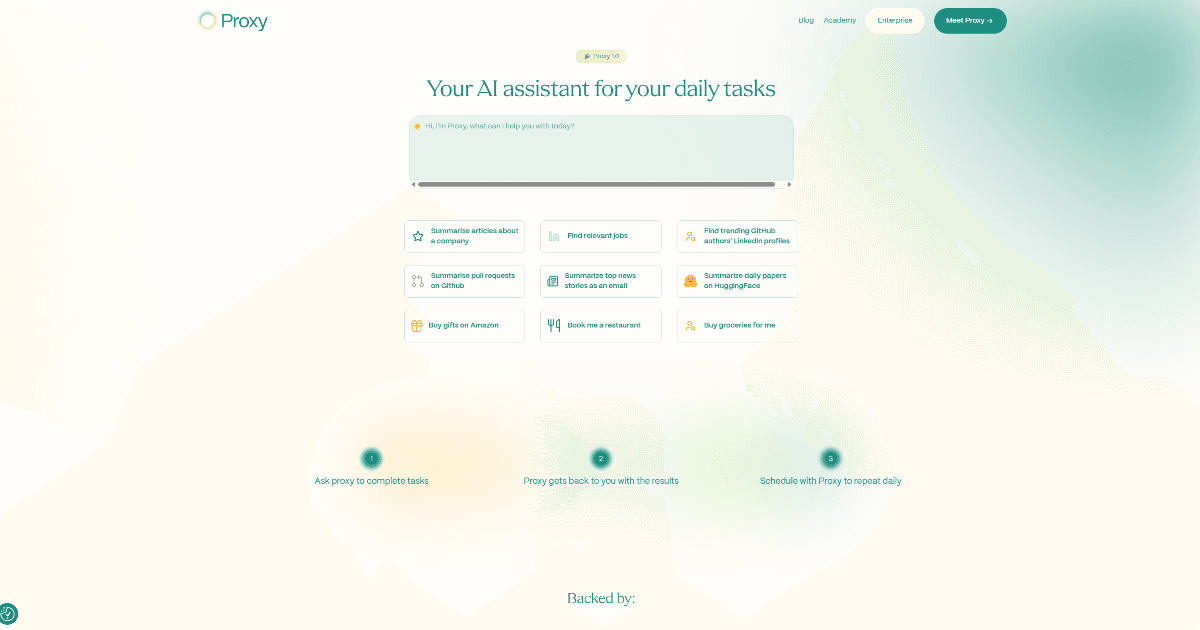
Convergence is a company focused on developing artificial intelligence to enhance productivity. Its flagship product, Proxy, is a digital assistant designed to automate a wide array of tasks, from scheduling and email management to data entry and online research. By interacting with web interfaces autonomously, Proxy simplifies complex workflows, allowing users to concentrate on higher-value strategic work.
This tool represents a significant step in the evolution of AI automation tools, moving beyond simple chatbots to agents that can execute multi-step processes independently.
What is Convergence?
Convergence's primary offering, Proxy, is an AI agent that acts as a personal assistant capable of understanding natural language instructions and performing tasks across the web. It is built to learn from interactions, applying past knowledge to new challenges, which enables a more collaborative and evolving partnership between the user and the AI.
Unlike static automation scripts, Proxy is designed for adaptability, positioning it as a versatile personal assistant for a digital workspace.
Key Features
- Natural Language Interface: Users can delegate tasks using everyday language, making the tool accessible without technical expertise.
- Web Interaction & Automation: Proxy can navigate websites, fill out forms, and interact with online content to complete complex, multi-step tasks autonomously.
- Parallel Processing: The Pro tier supports up to 20 parallel sessions, allowing Proxy to handle multiple tasks simultaneously without performance degradation.
- Long-Term Memory: The assistant retains and recalls information from past interactions, enabling continuous learning and context-aware assistance over time.
- Scheduled Automation: Users can configure tasks to run automatically at specified intervals, creating a 'set and forget' system for recurring workflows.
Use Cases
- Professionals automating email management, calendar scheduling, and data entry to reclaim hours in their workday.
- Managers and teams streamlining office administration, such as aggregating customer feedback or summarizing lengthy email threads.
- Researchers and academics receiving daily digests of the latest publications and insights in their field.
- Developers automating code review summaries, pull request analyses, and reducing the need for synchronous meetings.
- Freelancers and small businesses managing client communications, booking systems, and other repetitive administrative tasks.
Underlying AI Models or Technology
Convergence's technology is centered on its proprietary Large Meta Learning Models (LMLMs). These models are designed not just for task execution but for skill acquisition and continuous evolution. At its core, Proxy leverages advanced natural language processing to interpret user intent and instructions.
This is combined with robust language generation capabilities and web automation frameworks that allow the AI to navigate and interact with graphical user interfaces. The LMLM architecture enables the system to learn from each interaction, building a long-term memory that informs future tasks and reduces the need for constant retraining on new data.
Pricing
Convergence offers a freemium model for its Proxy assistant. The Free tier is designed for personal use and includes 5 sessions per day, support for up to 5 parallel sessions, and 1 automation. The Pro tier, priced at $20 per month for individuals, provides unlimited sessions, up to 20 parallel sessions, and 20 automations.
For large teams and organizations, an Enterprise plan with custom pricing and advanced features is available. It is recommended to visit the official Convergence website for the most current and detailed pricing information.
Pros and Cons
Pros
- Significant Time Savings: Automates routine administrative and web-based tasks, freeing users to focus on core work.
- Cost-Effective Pro Tier: At $20 per month, it offers substantial automation capabilities at a competitive price point.
- User-Friendly Natural Language Interface: Lowers the barrier to entry, allowing non-technical users to set up and manage automations easily.
- Continuous Learning: The long-term memory feature allows the assistant to improve and provide more contextual assistance over time.
Cons
- Initial Learning Curve: The breadth of features and automation possibilities may require an investment of time to master fully.
- Limited Free Tier: The free version's session and automation limits may be restrictive for users with frequent or complex automation needs.
- Dependence on Internet Connectivity: As a web-based tool that interacts with online services, a stable internet connection is essential for reliable operation.
Alternatives
For teams seeking automation, several other platforms offer workflow automation solutions with different focuses.
- Zapier and Make (formerly Integromat): Specialize in connecting web apps through pre-built integrations and visual workflow builders, ideal for automating data transfer between services.
- Adept.ai: An AI agent focused on training models to perform general computer tasks using natural language, similar in its goal of automating digital workflows.
- Bardeen and Rewind.ai: Offer automation focused on personal productivity, with features like macro recording and context-aware assistance, though with potentially different technical approaches.
Frequently Asked Questions
Embed This Tool
Add this badge to your website to show that Convergence is featured on AIPortalX.

Featured on AIPortalXConvergence
to leave a comment