
Cleric
Autonomously triages and roots cause alerts in complex infrastructures.
Contact for Pricing
-
Quick Info
Launch Date4 Aug '25
PricingContact for Pricing
Cleric – Autonomous AI for Infrastructure Alert Triage and Root Cause Analysis
Managing complex, modern infrastructure generates a constant stream of alerts that can overwhelm IT and DevOps teams. Cleric is an AI-powered agent designed to autonomously handle this critical operational burden. By automatically investigating, triaging, and diagnosing the root cause of alerts in environments like Kubernetes and cloud platforms, it transforms reactive firefighting into proactive system management. This tool is part of a growing ecosystem of AI agents and automation tools aimed at enhancing operational efficiency and reliability.
Cleric operates with a privacy-first, read-only approach, deploying within a user's Virtual Private Cloud (VPC) to ensure data safety while providing intelligent insights that drastically reduce mean time to resolution (MTTR). For teams seeking to streamline their workflow automation, Cleric offers a sophisticated solution that learns from infrastructure context to make informed decisions.
What is Cleric?
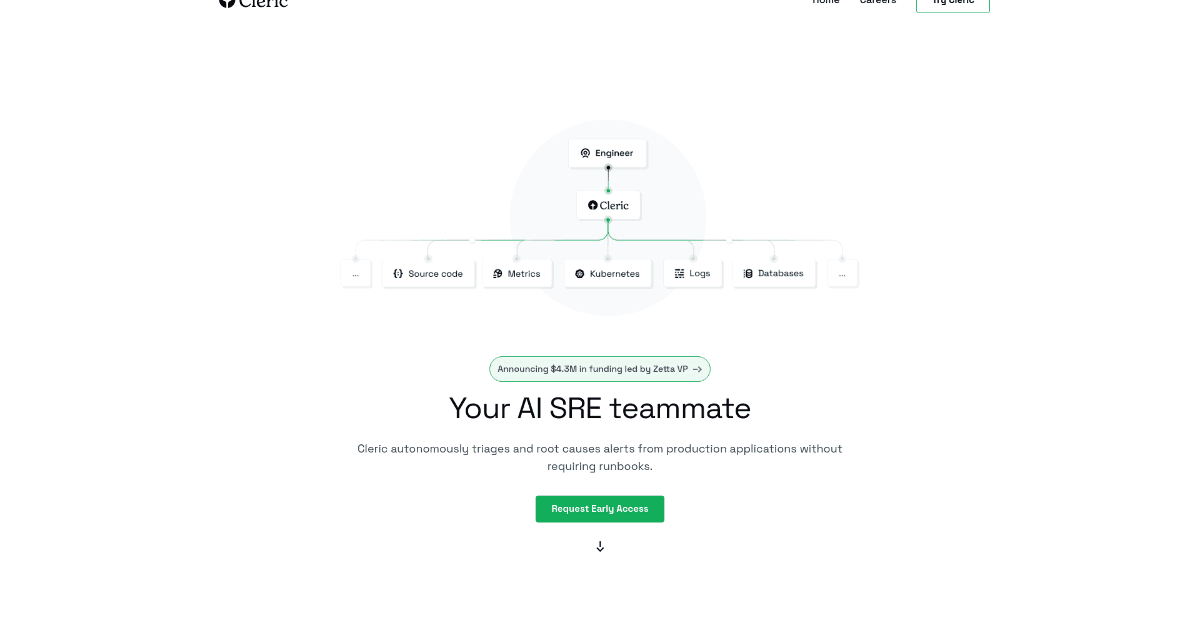
Cleric is an autonomous AI agent built specifically for production application environments. Its core function is to eliminate the manual, time-consuming process of alert investigation. Instead of requiring engineers to sift through logs, metrics, and runbooks, Cleric takes an alert, autonomously gathers relevant evidence, and proposes a root cause. It is engineered for the scale and complexity of modern microservices and cloud-native architectures, where traditional manual methods fall short.
The tool is designed for IT professionals, DevOps engineers, and site reliability engineers (SREs) who manage critical digital services. By acting as a first responder, Cleric filters out noise, prioritizes genuinely critical issues, and provides diagnostic reasoning, allowing human experts to focus on higher-level strategy and complex problem-solving. It represents a shift towards self-healing infrastructure and intelligent operational automation.
Key Features
Autonomous Alert Investigation: Automatically collects and synthesizes evidence from logs, metrics, and traces to justify a root cause proposal without manual intervention.
Intelligent Runbook Execution: Selects and executes the most appropriate predefined runbook for a given alert. If the runbook is insufficient, it employs first-principles reasoning to diagnose the issue.
Critical Alert Prioritization: Triages alerts at scale, identifying and surfacing only the high-severity issues that require immediate human attention, reducing alert fatigue.
Privacy & Safety Design: Operates with read-only access and can be deployed entirely within your VPC, ensuring no sensitive data leaves your environment.
API for Integration: Offers API access for custom integrations and extensibility within existing toolchains and dashboards.
Use Cases
DevOps teams managing overnight or weekend on-call rotations, using Cleric as a first-line responder to assess and diagnose alerts.
SREs at e-commerce companies during peak sales events, where system stability is critical and alert volume is high.
Platform engineering teams supporting multiple internal product teams, needing to efficiently triage issues across many services.
IT administrators in financial services or healthcare, where compliance requires strict data privacy and detailed audit trails of incident response.
Startups with small engineering teams that need to maintain high reliability without a large dedicated operations staff.
Underlying AI Models or Technology
Cleric leverages advanced natural language processing (NLP) and reasoning models to understand unstructured log data, correlate events across different data sources, and apply logical reasoning to diagnose problems. Its technology stack is likely built upon large language models (LLMs) fine-tuned for technical domains, enabling it to interpret system metrics, error messages, and operational playbooks. This allows Cleric to move beyond simple pattern matching to genuine causal inference.
The agent's "first-principles reasoning" capability suggests the use of models trained for complex question answering and logical deduction, allowing it to construct a diagnostic chain of thought when pre-defined solutions are inadequate. By integrating with observability platforms, Cleric applies this AI to the rich context of live infrastructure, continuously learning from the environment to improve its accuracy.
Pricing
Cleric is currently available through an early access program. Interested users must join a waitlist to request access. The official pricing structure is not publicly listed, indicating a likely enterprise or custom pricing model based on factors such as infrastructure scale, number of nodes, or alert volume. For the most accurate and current pricing details, visitors should refer to the official Cleric website.
Pros and Cons
Pros
Significantly reduces mean time to resolution (MTTR) by automating the initial investigation and evidence-gathering phase.
Reduces alert fatigue for engineering teams by intelligently prioritizing only critical issues.
Strong privacy and security posture with read-only access and in-VPC deployment options.
Designed for scalability, capable of managing alert volumes in large, complex cloud-native environments.
Cons
New users may face a learning curve to integrate and configure the tool effectively within their specific operational workflows.
As a newer tool in early access, public documentation and community knowledge may be limited compared to established platforms.
Performance and effectiveness are dependent on the quality and accessibility of the user's existing observability data (logs, metrics, traces).
Alternatives
Teams exploring autonomous operations and AI-driven incident management have several other options to consider:
PagerDuty Process Automation: Offers runbook automation and incident response workflows with strong integrations, though with potentially less autonomous AI reasoning.
BigPanda: Uses AI and machine learning for event correlation and noise reduction, focusing on aggregating and enriching alerts before they reach teams.
Opsgenie by Atlassian: Provides robust alert routing, on-call scheduling, and escalation policies, often used in conjunction with other tools for the automation layer.
StackState: Focuses on topology-aware observability and AIOps, using a graph-based model to understand service dependencies and perform root cause analysis.
Frequently Asked Questions
Embed This Tool
Add this badge to your website to show that Cleric is featured on AIPortalX.

Featured on AIPortalXCleric
to leave a comment