
Causa
Unlock causal ML insights for strategic, data-driven decisions.
Contact for Pricing
-
Quick Info
Launch Date4 Aug '25
PricingContact for Pricing
Collections
Categories
Causa – Unlock causal ML insights for strategic, data-driven decisions.
Causa is a specialized platform that empowers organizations to move beyond correlation and understand the causal relationships within their data. By leveraging causal machine learning, it provides a framework for making strategic decisions that directly impact efficiency and profitability. This approach is particularly valuable for businesses looking to optimize complex operations where understanding the 'why' is as critical as the 'what'.
As part of the broader ecosystem of AI agents, Causa automates advanced analytical reasoning, integrating seamlessly into existing workflows to deliver actionable intelligence.
What is Causa?
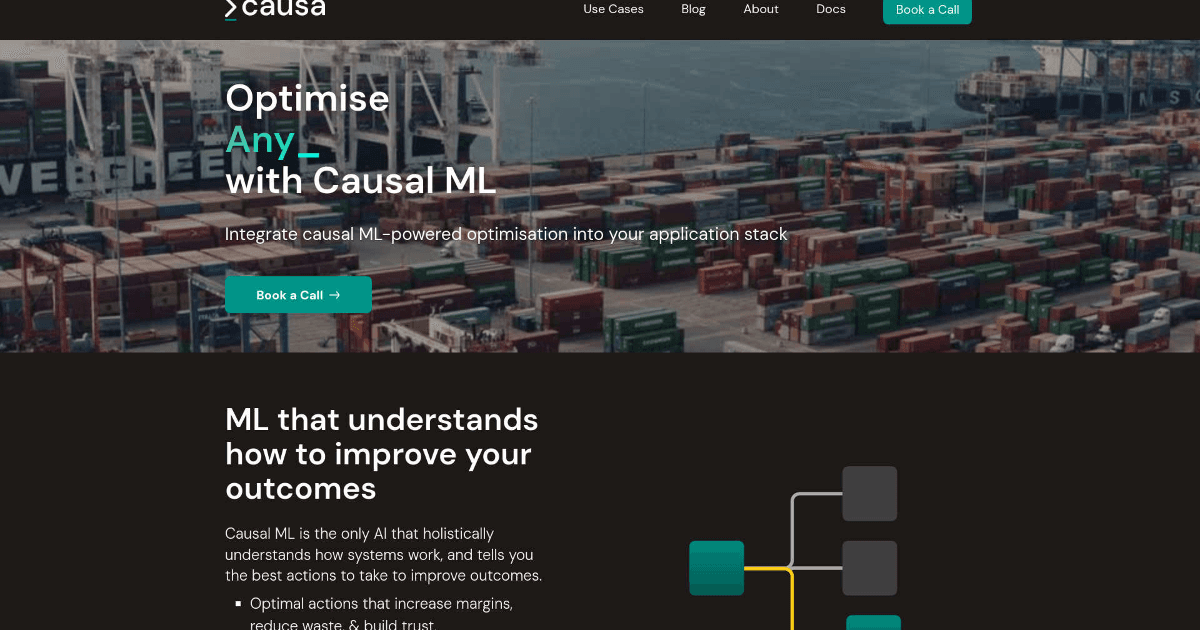
Causa is an advanced platform dedicated to harnessing the power of causal machine learning (ML) to optimize business operations across various industries. It provides a comprehensive ecosystem for data analysis, enabling organizations to make data-driven decisions that drive efficiency, reduce waste, and boost profitability.
Causa integrates seamlessly into existing applications, offering robust analytics through an intuitive and scalable cloud-native solution, positioning it as a powerful tool within the AI Assistants & Automation landscape.
Key Features
- CausaDB: A powerful platform for integrating causal ML into applications, offering a robust framework for in-depth data analysis and decision-making.
- Cloud-Native Infrastructure: Provides a scalable solution that grows with your business needs.
- SDK & REST API Integration: Compatible with popular programming environments such as Python and Node.
- Optimal Action Recommendations: Uses advanced algorithms to suggest actions that will achieve specific business outcomes.
- Action Simulation: Enables users to simulate potential actions and view predicted outcomes before implementation.
- Adaptive Experiments: Includes smart tools for adjusting experiments based on data sufficiency.
Use Cases
- Manufacturing Companies: Optimizing production processes to improve yield and reduce waste.
- Healthcare Providers: Enhancing patient outcomes and operational efficiency in clinical settings.
- Energy Companies: Managing and predicting energy demands to minimize costs.
- Supply Chain Managers: Improving resilience and efficiency in supply chain operations.
- Financial Analysts: Employing causal analysis for risk assessment and mitigation strategies.
Underlying AI Models or Technology
Causa's core technology is built upon causal inference and machine learning models. Unlike traditional predictive models that identify correlations, causal ML aims to understand the cause-and-effect relationships within data. This often involves sophisticated statistical models and algorithms that can isolate variables and estimate treatment effects. The platform's ability to recommend optimal actions and simulate outcomes relies on these foundational language and reasoning models that interpret complex datasets.
By framing business optimization as a series of causal questions, the platform leverages techniques akin to advanced question-answering systems, providing clear answers about what actions will lead to desired outcomes. This makes it a powerful tool for strategic planning where counterfactual reasoning is essential.
Pricing
Causa operates on a "Contact for Pricing" model. It offers a cloud package with a base plan scalable according to business size and needs. For large organizations, custom enterprise solutions are available, which include comprehensive support and integration services.
For the most accurate and current pricing details, users should refer to the official Causa website.
Pros and Cons
Pros
- Provides deep, causal insights for strategic decision-making beyond simple correlations.
- Cloud-native features ensure seamless scalability as business needs grow.
- User-friendly interface designed to be accessible to users without extensive technical knowledge.
- Offers actionable recommendations to maximize ROI by identifying impactful actions.
Cons
- Most beneficial for companies with specific needs for causal analysis, which may not apply to all industries.
- New users may need time to understand and fully utilize causal ML's potential applications.
- Potential challenges in integrating with legacy systems that are not compatible with modern APIs.
Alternatives
Organizations seeking different approaches to data-driven optimization may consider these categories of tools:
- General-Purpose Business Intelligence (BI) Platforms: Tools like Tableau or Power BI focus on data visualization and descriptive analytics, offering broad insights but typically lack built-in causal inference capabilities.
- Predictive Analytics Suites: Platforms that use traditional machine learning for forecasting future trends based on historical data, which differs from Causa's focus on causal relationships.
- Specialized Causal Inference Libraries: Open-source libraries like DoWhy or CausalML (often used with Python) provide the underlying statistical tools for experts to build custom causal models, requiring more technical expertise than an integrated platform like Causa.
- Academic and research-focused software designed for experimental design and statistical analysis, which may overlap in methodology but are not always packaged for direct business application.
Frequently Asked Questions
Embed This Tool
Add this badge to your website to show that Causa is featured on AIPortalX.

Featured on AIPortalXCausa
to leave a comment