
AutoGPT
Automate workflows with customizable AI agents seamlessly.
Free
-
Quick Info
Launch Date5 Dec '25
PricingFree
AutoGPT – Automate complex workflows with customizable AI agents
AutoGPT is an open-source platform that enables users to build, deploy, and manage autonomous AI agents for automating intricate tasks. Available on GitHub, it provides a suite of tools designed to make AI accessible for developers, business professionals, and tech enthusiasts. By handling repetitive and complex workflows, AutoGPT allows users to focus on strategic goals and innovation.
As a prominent tool in the AI agents category, it simplifies the creation of tailored AI solutions without requiring extensive coding expertise.
What is AutoGPT?
AutoGPT is a comprehensive framework for creating autonomous AI agents that can execute multi-step tasks based on high-level objectives. Its core mission is to democratize AI by providing powerful automation capabilities through a user-friendly interface. The platform is designed to manage the entire lifecycle of an AI agent, from initial configuration to deployment and monitoring.
It is part of a broader ecosystem of AI assistants and automation tools, focusing on enabling agents to perform actions, make decisions, and iterate towards a defined goal with minimal human intervention.
Key Features
Agent Builder: A low-code interface for designing and configuring custom AI agents tailored to specific tasks.
Workflow Management: An intuitive, block-based system for building, modifying, and optimizing automation sequences.
Deployment Controls: Tools to manage the testing, staging, and production lifecycle of AI agents.
Marketplace: A library of pre-built agents for instant deployment, accelerating development.
Open-Source Foundation: The core platform is freely available for download and self-hosting on GitHub.
Use Cases
Software Development: Automating coding tasks, code review, and generating documentation.
Digital Marketing: Streamlining content creation, social media scheduling, and campaign analysis.
Business Intelligence: Automating data collection, analysis, and report generation for analysts.
Product Innovation: Enabling startups to rapidly prototype and deploy AI-driven features and services.
Education & Healthcare: Teaching AI concepts in academic settings or managing administrative patient data.
Underlying AI Models or Technology
AutoGPT is built upon large language models (LLMs), leveraging advanced natural language processing to understand goals, break them into sub-tasks, and execute actions. The agents typically utilize models like GPT-4 to reason, plan, and generate text-based outputs.
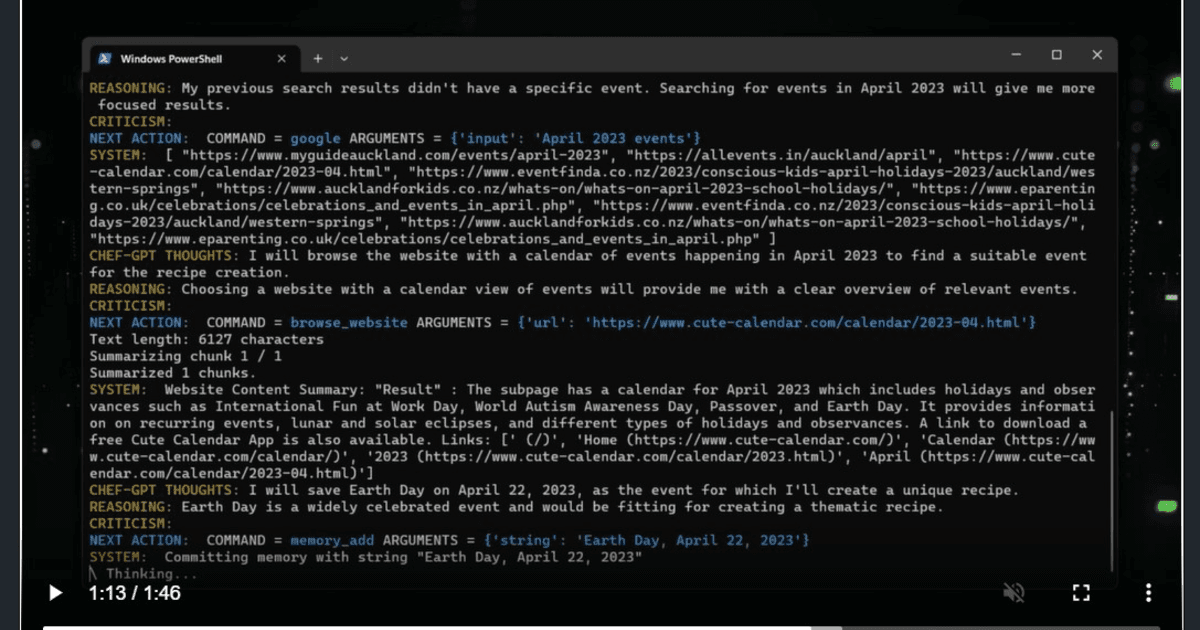
The system's autonomy stems from its ability to chain language generation with tool use (like web browsing or API calls), creating a loop where the agent assesses results and plans its next move until the objective is met.
Pricing
AutoGPT is fundamentally an open-source project. The core software is free to download and self-host. The primary costs for users are associated with running the underlying LLM APIs (like OpenAI's GPT-4) and any infrastructure for hosting.
The developers have announced a cloud-hosted beta version, which is currently accessible via a waitlist. Pricing for this managed service has not been publicly disclosed. For the most accurate and current details, refer to the official AutoGitHub repository.
Pros and Cons
Pros
High Customization: The low-code builder and open-source code allow for extensive tailoring to specific workflows.
Cost-Effective Foundation: Being open-source eliminates licensing fees for the core platform.
Powerful Automation: Capable of handling complex, multi-step tasks that would be time-consuming manually.
Active Community: Benefits from continuous development and shared knowledge via its GitHub repository.
Cons
Technical Setup Complexity: Self-hosting requires significant technical expertise in deployment and infrastructure management.
Learning Curve: Users must understand both the platform's concepts and the capabilities/limitations of the underlying LLMs.
Unpredictable Costs: While the tool is free, API costs for powerful LLMs can accumulate quickly with extensive use.
Alternatives
Several other platforms offer AI-powered automation and agent capabilities. When evaluating workflow automation tools, consider these alternatives:
BabyAGI: Another open-source project focused on task-driven autonomous agents, often compared directly with AutoGPT.
LangChain: A framework for developing applications powered by language models, offering more granular control for developers building agentic systems.
Zapier with AI: A commercial, no-code platform that integrates AI actions into extensive automated workflows between thousands of apps.
Microsoft Power Automate: An enterprise-grade solution for automating workflows across Microsoft and third-party services, increasingly incorporating AI capabilities.
Frequently Asked Questions
Embed This Tool
Add this badge to your website to show that AutoGPT is featured on AIPortalX.

Featured on AIPortalXAutoGPT
to leave a comment