
Appian
Streamline processes with AI-driven low-code automation platform.
Contact for Pricing
-
Quick Info
Launch Date4 Aug '25
PricingContact for Pricing
Categories
Appian – Streamline processes with AI-driven low-code automation
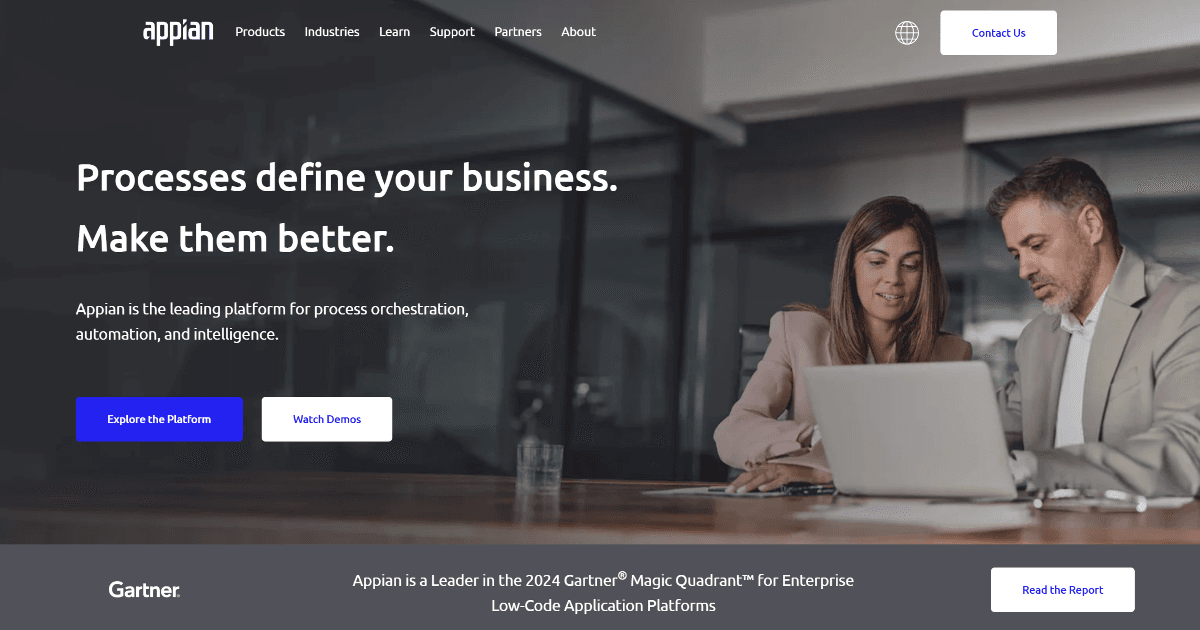
Appian is a comprehensive enterprise platform that integrates low-code application development with AI-driven process automation. It enables organizations to design, orchestrate, and optimize complex business workflows efficiently. Targeted at professionals across various industries, Appian simplifies digital transformation by unifying data and automating tasks within a single environment. For teams looking to enhance operational efficiency, exploring AI automation tools can provide valuable context for the broader landscape.
The platform is particularly relevant for sectors like finance, insurance, and the public sector, where compliance, data integrity, and process speed are critical. By reducing the technical barrier to application development, Appian empowers business teams to build solutions that address specific operational challenges without relying solely on IT departments.
What is Appian?
Appian is a leader in the enterprise low-code application and process automation market. It provides an integrated environment where businesses can model processes, build applications, integrate data from disparate sources, and deploy AI agents to automate decisions and tasks. The platform is designed to handle the full lifecycle of business process management.
Its core value proposition lies in unifying process mining, workflow automation, robotic process automation (RPA), and intelligent document processing (IDP) into a single, cohesive platform. This approach helps organizations move away from siloed systems and manual work, enabling faster response times and more agile operations. For foundational technology, Appian leverages advancements in natural language processing to power its AI copilots and agents.
Key Features
Low-Code Development Environment: Enables rapid application building with visual designers and pre-built components, minimizing the need for extensive coding.
AI Integration and Copilots: Embeds AI agents to assist with decision-making, data extraction, and automating routine process steps.
Unified Data Fabric: Connects and harmonizes data from various legacy systems, databases, and applications into a single virtual layer for a comprehensive operational view.
End-to-End Process Automation: Combines workflow orchestration, RPA, and IDP to automate complex, multi-step business processes from start to finish.
Scalable Architecture: Built to support enterprise-grade deployments, handling large volumes of transactions and users as business needs grow.
Comprehensive Integration: Offers connectors and APIs to integrate with a wide range of third-party enterprise software, CRM, ERP, and custom systems.
Use Cases
Financial Services: Automating regulatory compliance checks, loan origination processes, and customer onboarding lifecycle management.
Insurance: Streamlining underwriting assessments, claims processing, and fraud detection workflows to improve efficiency and accuracy.
Public Sector: Modernizing legacy systems for procurement, citizen services, and case management to increase transparency and reduce processing times.
Healthcare: Managing patient intake, records processing, and administrative workflows to allow staff to focus more on patient care.
Telecommunications: Optimizing order fulfillment, service provisioning, and customer issue resolution processes.
Underlying AI Models or Technology
Appian incorporates AI and machine learning to enhance its automation capabilities. Its AI Copilot feature leverages natural language processing to understand user requests and generate process models, application components, or SQL queries. For document-intensive processes, it uses intelligent document processing (IDP) powered by computer vision and text classification models to extract and validate data from unstructured documents like forms and invoices.
The platform's process mining functionality uses AI to analyze event logs and discover inefficiencies in existing workflows, suggesting optimizations. While Appian does not publicly detail all underlying model architectures, its technology is focused on applying AI to practical business automation challenges, making complex language generation and data extraction capabilities accessible within a low-code framework.
Pricing
Appian operates on a contact-for-pricing model, which is standard for enterprise-grade platforms. Pricing is typically based on factors such as the number of users, the scale of automation processes, the level of support required, and deployment options (cloud, on-premise, or hybrid).
The company offers a free trial that allows potential users to explore the platform's core features. For the most accurate and current pricing details, it is necessary to contact Appian's sales team directly through their official website.
Pros and Cons
Pros
Significantly accelerates application development and deployment timelines through its intuitive low-code environment.
Provides a unified platform for process mining, workflow automation, RPA, and AI, reducing tool sprawl.
Strong enterprise-grade security, compliance features, and scalability for large organizations.
Effective at breaking down data silos with its data fabric, enabling better decision-making.
Cons
The total cost of ownership can be high, especially for small to mid-sized businesses, making it a significant investment.
Mastering the platform's full range of advanced capabilities for complex automations requires a notable learning curve and training.
While highly flexible, extremely niche or unique customization requirements may still demand specialized development effort.
Alternatives
Organizations evaluating Appian may also consider other platforms in the low-code and process automation space. The right choice often depends on specific needs around integration depth, industry focus, and budget. Other notable categories include workflow automation tools and broader business process management suites.
UiPath: A leader in Robotic Process Automation (RPA) with a strong focus on attended and unattended desktop automation, often used in conjunction with other process tools.
ServiceNow: Offers a robust platform for IT service management (ITSM) and enterprise service management, with strong workflow capabilities for internal service delivery.
Microsoft Power Platform: A suite of low-code tools (Power Apps, Power Automate) deeply integrated with the Microsoft ecosystem, suitable for organizations heavily invested in Microsoft 365 and Azure.
Pega Platform: Provides a competitive low-code environment for case management and decision automation, with a strong rules engine for complex business logic.
Frequently Asked Questions
Embed This Tool
Add this badge to your website to show that Appian is featured on AIPortalX.

Featured on AIPortalXAppian
to leave a comment