
TextQL
Simplifies complex data operations with natural language querying.
Contact for Pricing
-
Quick Info
Launch Date4 Aug '25
PricingContact for Pricing
Collections
TextQL – Query Your Data Using Natural Language
In today's data-driven business environment, extracting actionable insights from complex datasets remains a significant challenge for many teams. TextQL addresses this by acting as a virtual data analyst, enabling users to interact with their data using simple, conversational language. This approach significantly lowers the barrier to entry for data analytics, making it accessible beyond specialized data science teams.
The platform is designed for enterprises and professionals who need to leverage data for decision-making but lack the time or technical expertise for traditional query languages. By integrating with existing business intelligence systems, TextQL helps reduce dashboard sprawl and centralizes data discovery, positioning itself as a key tool in the marketing and sales operations landscape.
What is TextQL?
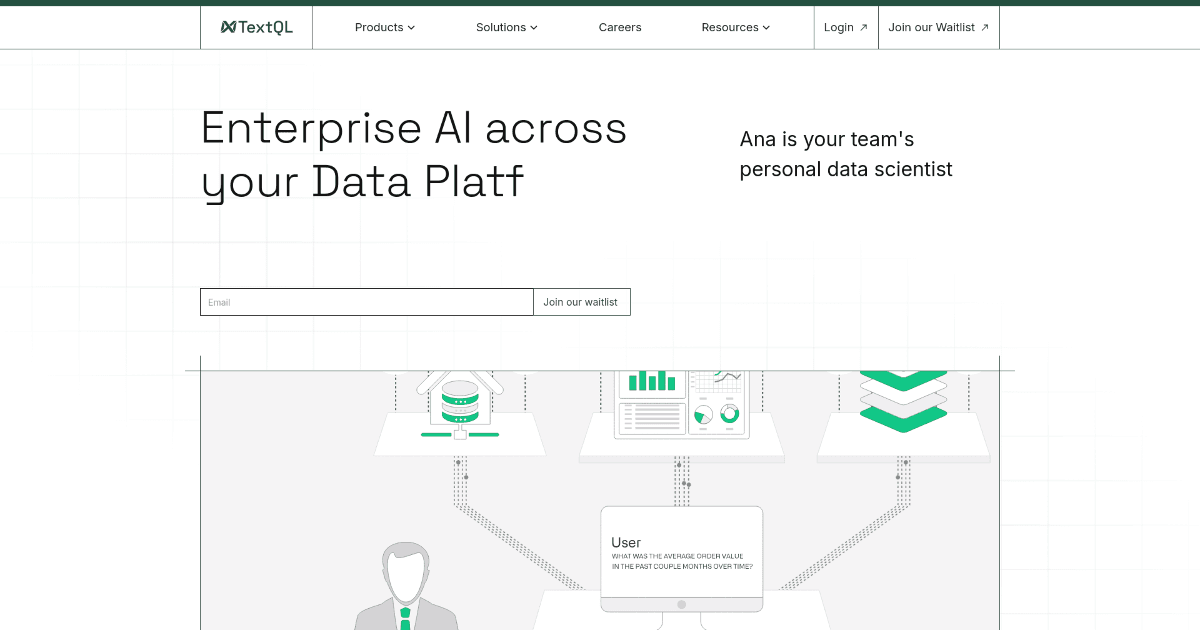
TextQL is an AI-powered analytics platform that simplifies complex data operations through natural language querying. It serves as an intermediary layer between users and their data warehouses or BI tools, translating plain English questions into executable queries. The core value proposition is democratizing data access, allowing marketers, finance professionals, and operational teams to generate insights without relying on SQL experts or data engineers.
The tool is engineered to understand business context and terminology, making it particularly effective for organizations with established data ecosystems. It fits well within broader collections of AI assistants and automation tools designed to enhance workplace productivity.
Key Features
Natural Language Interface: Allows users to query databases and analytics platforms using conversational English, eliminating the need to learn SQL or other query languages.
BI System Integration: Seamlessly connects with existing business intelligence platforms to centralize reporting and reduce the proliferation of disparate dashboards.
Advanced Metadata Management: Indexes and surfaces data definitions, column descriptions, and business logic from across an organization's data platforms.
Compliance and Security Configurations: Offers settings to meet various data governance and compliance standards, ensuring secure handling of sensitive information.
Collaboration Features: Integrates directly with workplace communication tools like Slack and Microsoft Teams for sharing insights and collaborative analysis.
Use Cases
Marketing Teams: Analyzing campaign performance, customer segmentation, and channel attribution without writing complex queries.
Finance Departments: Generating financial forecasts, conducting variance analysis, and preparing audit reports through natural language prompts.
Healthcare Administrators: Managing and querying large volumes of patient or operational data to identify trends and improve resource allocation.
Product Teams: Investigating user behavior data, feature adoption metrics, and A/B test results to inform product decisions.
Non-Profit Organizations: Measuring program impact, optimizing donor outreach strategies, and reporting on key performance indicators.
Underlying AI Models or Technology
TextQL leverages advanced natural language processing (NLP) and machine learning models to interpret user intent and translate it into accurate database queries. The system is built upon foundational language models that are fine-tuned specifically for understanding business terminology, data schema context, and analytical intent.
A key technological component is its semantic understanding layer, which maps natural language phrases to specific database columns, tables, and business metrics. This goes beyond simple keyword matching to grasp the relationships within data. The platform's ability to generate syntactically correct SQL or other query language code demonstrates sophisticated code generation capabilities tailored for data interaction.
Pricing
TextQL operates on an enterprise custom pricing model. Costs are determined based on the specific scale of deployment, number of users, volume of data queries, and the level of integration and customization required. Organizations typically need to contact the sales team for a detailed quote tailored to their use case and infrastructure.
Pros and Cons
Pros
Democratizes data access by enabling non-technical users to perform complex analyses.
Reduces time-to-insight by eliminating the need to write and debug SQL queries manually.
Centralizes data discovery and reduces dependency on multiple, siloed analytics dashboards.
Offers robust security and compliance configurations suitable for enterprise environments.
Cons
Implementation can require a detailed setup process to integrate fully with an organization's existing data stack.
Analytical accuracy is inherently dependent on the quality, structure, and documentation of the underlying source data.
Natural language processing may have limitations with non-English queries or highly niche business jargon without customization.
Alternatives
Several other platforms offer natural language interfaces for data querying, often as part of larger business intelligence and research tools.
ThoughtSpot: A search and AI-driven analytics platform that allows users to ask questions in natural language to get insights from their data.
Microsoft Power BI Q&A: A feature within the Power BI suite that lets users ask questions about their data using conversational language.
Tableau Ask Data: Provides a natural language interface within Tableau for querying datasets and creating visualizations.
Google Looker (LookML & Explores): While more technical, it offers semantic modeling layers that can simplify data exploration for business users.
Frequently Asked Questions
Embed This Tool
Add this badge to your website to show that TextQL is featured on AIPortalX.

Featured on AIPortalXTextQL
to leave a comment