
Airbook
Unify business data, discover insights, drive growth.
Freemium
-
Quick Info
Launch Date13 Aug '25
PricingFreemium
Collections
Categories
Airbook – Unify business data, discover insights, and drive growth.
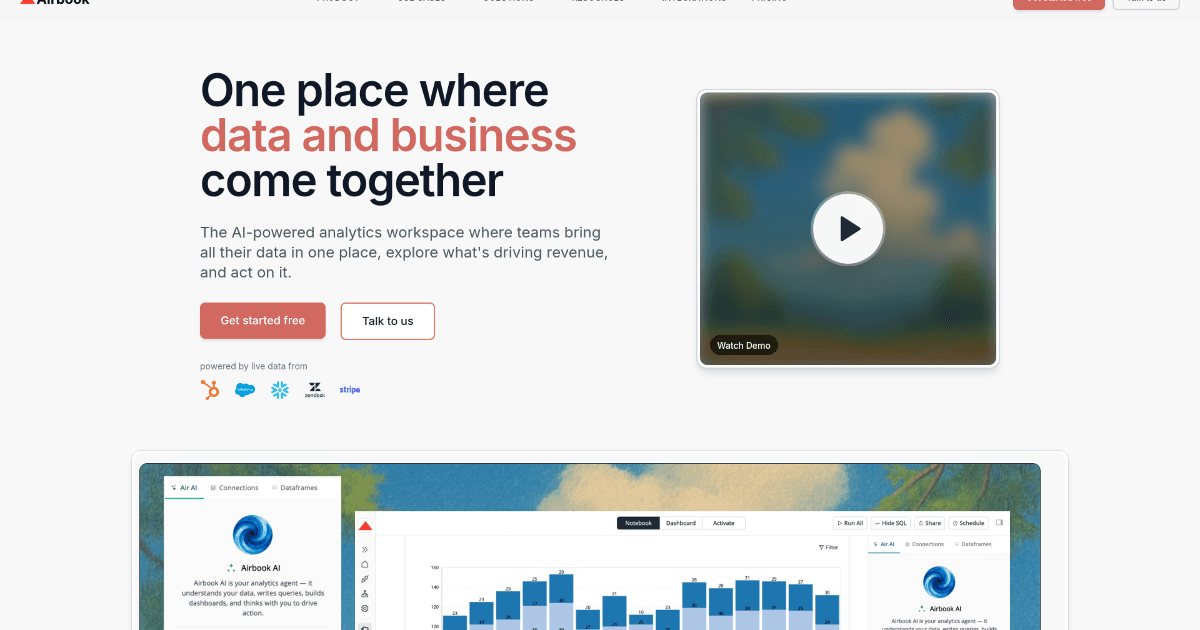
Airbook is an AI-powered platform that transforms how businesses handle data analytics and operations. It brings together disparate business data into a single, intuitive workspace, enabling teams to explore revenue-driving insights and take action based on real-time information. This makes it a powerful solution for professionals across sales, marketing, and operations who need to enhance efficiency and accelerate growth.
By centralizing data from CRMs, marketing tools, and finance systems, Airbook simplifies complex analysis without requiring deep engineering expertise. Its collaborative features allow teams to build and act on insights together, making it a cornerstone for modern data-driven business strategies.
What is Airbook?
Airbook is a cutting-edge platform designed to unify business data, analytics, and operations. At its core, it provides a single workspace where teams can connect data from various sources, analyze it using AI, and collaborate on insights. The platform is built to answer complex analytical questions in plain English, making advanced data capabilities accessible to a broader range of business users.
This approach eliminates data silos and reduces dependency on specialized data engineering teams. Airbook empowers professionals to focus on strategic decision-making and growth, positioning it as a comprehensive solution within the broader ecosystem of AI-powered business and marketing tools.
Key Features
- AI-Driven Analytics: Provides real-time insights and answers to complex analytical questions in plain English.
- Unified Data Platform: Centralizes data from CRMs, marketing tools, and finance systems for analysis without engineering expertise.
- Collaborative Workspace: Offers a single platform for teams to build and act on insights with real-time collaboration.
- Extensive Integration Capabilities: Connects with various business tools and databases to provide clean, actionable data.
- User-Friendly Interface: An intuitive design accessible to users with different levels of technical expertise.
Use Cases
- E-commerce Businesses: Streamlining data from sales and marketing channels for accurate revenue tracking and forecasting.
- Digital Marketing Agencies: Measuring campaign effectiveness, ROI, and optimizing marketing spend across channels.
- Sales Teams: Enhancing lead conversion rates and pipeline management through unified data views and predictive insights.
- Financial Analysts: Conducting comprehensive financial data analysis, reporting, and scenario modeling.
- Educational Institutions: Adopted as a teaching tool for practical data analytics courses.
- Non-Profit Organizations: Analyzing donor data, campaign performance, and operational efficiency.
Underlying AI Models or Technology
Airbook leverages advanced AI algorithms to power its analytics engine. The platform utilizes natural language processing (NLP) to interpret user queries posed in plain English and translate them into complex data operations. This capability is built upon foundational language models that understand context and intent.
Beyond NLP, the system employs machine learning for pattern recognition, anomaly detection, and predictive analytics within unified datasets. These technologies enable features like automated insight generation and forecasting. The platform's ability to provide instant, conversational answers to data questions represents a practical application of advanced question-answering and language generation capabilities tailored for business intelligence.
Pricing
Airbook operates on a freemium model with several tiered plans:
- Freemium: $0 per month. Includes 10 AI requests, 1 analyst seat, 1 database connection, unlimited viewers, and 2 projects.
- Starter: $99 per month. Includes 50 AI requests, 2 analyst seats, 1 database or warehouse, and unlimited projects.
- Growth: $599 per month. Includes 100 AI requests, 5 analyst seats, CRM connection, scheduled reports, and no-code query builder.
- Scale: $1,499 per month. Includes 500 AI requests, 5 analyst seats, any 5 connectors, cross-source insights, and trigger workflows.
Please note that pricing information may change. For the most accurate and current details, refer to the official Airbook website.
Pros and Cons
Pros
- Significant Time Efficiency: Drastically reduces time spent on pipeline reviews and manual data analysis.
- Cost-Effective Solution: Consolidates multiple traditional data tools into a single, affordable platform.
- Real-Time Insights: Provides immediate visibility into campaign impacts and key revenue-driving factors.
Cons
- Initial Learning Curve: Users may require time to fully utilize all the platform's advanced features and workflows.
- Integration Limitations: While extensive, the platform may not support every niche or legacy third-party system.
- Customization Needs: Some organizations with unique processes may require additional setup or customization.
Alternatives
Businesses seeking similar data unification and AI analytics capabilities can explore other platforms. When evaluating AI tools for business intelligence, consider the following alternatives:
- Tableau: A veteran in data visualization and business intelligence, offering powerful dashboards and reporting.
- Microsoft Power BI: Integrates deeply with the Microsoft ecosystem, providing robust analytics and data modeling.
- Looker (Google Cloud): Focuses on data exploration and embedded analytics with a strong semantic modeling layer.
- Sigma Computing: Offers a spreadsheet-like interface for live data exploration on cloud data warehouses.
- ThoughtSpot: Emphasizes AI-powered search and natural language querying for business data.
Frequently Asked Questions
Embed This Tool
Add this badge to your website to show that Airbook is featured on AIPortalX.

Featured on AIPortalXAirbook
to leave a comment